Shenandoah National Park: A Complete First-Timer’s Guide
Just 75 miles from Washington DC, the Blue Ridge Mountains rise into a long, narrow ribbon of protected wilderness — and this Shenandoah National Park guide is here to help you make the most of it. Think 105 miles of one of America’s prettiest scenic drives, waterfalls tucked into hollows, a rock scramble that’s earned cult status, and some of the best fall foliage on the East Coast. It’s the rare big park you can reach on a whim from a major city, yet still feel a hundred miles from anywhere.
If it’s your first visit, the long, skinny shape of the park can be confusing — where do you even start on a road that runs over a hundred miles? This guide breaks it down so you know which overlooks, trails, and waterfalls are worth your time, when to come, and how to dodge the worst of the crowds.
- Shenandoah is built around Skyline Drive, a 105-mile scenic road with 75 overlooks running the length of the park.
- Old Rag is the headline hike — a thrilling rock scramble that now requires a day-use ticket in peak season.
- Dark Hollow Falls is the most popular waterfall hike, short and rewarding (but steep on the way back).
- Fall foliage is the busiest and most beautiful season, peaking from early to mid-October.
- It’s one of the easiest national parks to reach from a major city — about 1.5 hours from Washington DC.
| 📍 Location | Northern Virginia (Blue Ridge Mountains) |
| 💰 Entrance fee | Per-vehicle fee, valid 7 days (check current rate) |
| 🚗 Main feature | Skyline Drive (105 miles, 75 overlooks) |
| ⏱️ Ideal stay | 2–3 days |
| 🗓️ Best time | Fall (October foliage); spring for wildflowers |
| 🥾 Famous for | Old Rag scramble, waterfalls, easy DC access |
| 🎫 Heads up | Old Rag requires a day-use ticket in peak season |
Plan around Old Rag: The park’s most famous hike now uses a day-use ticket system during the busy season (typically March–November). If Old Rag is on your list, book ahead on recreation.gov — they sell out.
Shenandoah’s biggest selling point is access. It’s one of the few national parks you can comfortably visit as a long weekend trip — or even a day trip — from a major metro area.
Nearest airports:
- Washington Dulles (IAD) — about 1 to 1.5 hours to the closest park entrances
- Reagan National (DCA) — a bit farther, but still easy
- Richmond (RIC) and Charlottesville (CHO) — convenient for the southern districts
The four entrances (north to south):
- Front Royal (North Entrance) — closest to DC, Mile 0 of Skyline Drive
- Thornton Gap — near Luray, splits the park into north and central districts
- Swift Run Gap — central/south access near Elkton
- Rockfish Gap (South Entrance) — connects directly to the Blue Ridge Parkway
Getting around: You absolutely need a car. There’s no shuttle, and the entire park experience is organized around driving Skyline Drive and stopping at overlooks and trailheads along the way. Speed limit is a leisurely 35 mph the whole length — by design.
Here’s the key thing first-timers need to grasp: Shenandoah is long and skinny. Skyline Drive runs north–south for 105 miles down the spine of the Blue Ridge, and almost everything you’ll do branches off it. Mileposts (numbered 0 at Front Royal to 105 at Rockfish Gap) are how everyone navigates — trailheads, overlooks, and visitor centers are all referenced by their milepost.
The park is divided into three districts:
| District | Mileposts | Vibe | Highlights |
|---|---|---|---|
| North | 0–31.5 | Closest to DC, busiest | Overlooks, easy access |
| Central | 31.5–65.5 | The heart of the park | Old Rag, Dark Hollow Falls, Big Meadows, Skyland |
| South | 65.5–105 | Quietest, most remote | Solitude, fewer crowds, Blackrock |
If you only have one day, focus on the Central District — it packs in the best hikes, waterfalls, and visitor services.
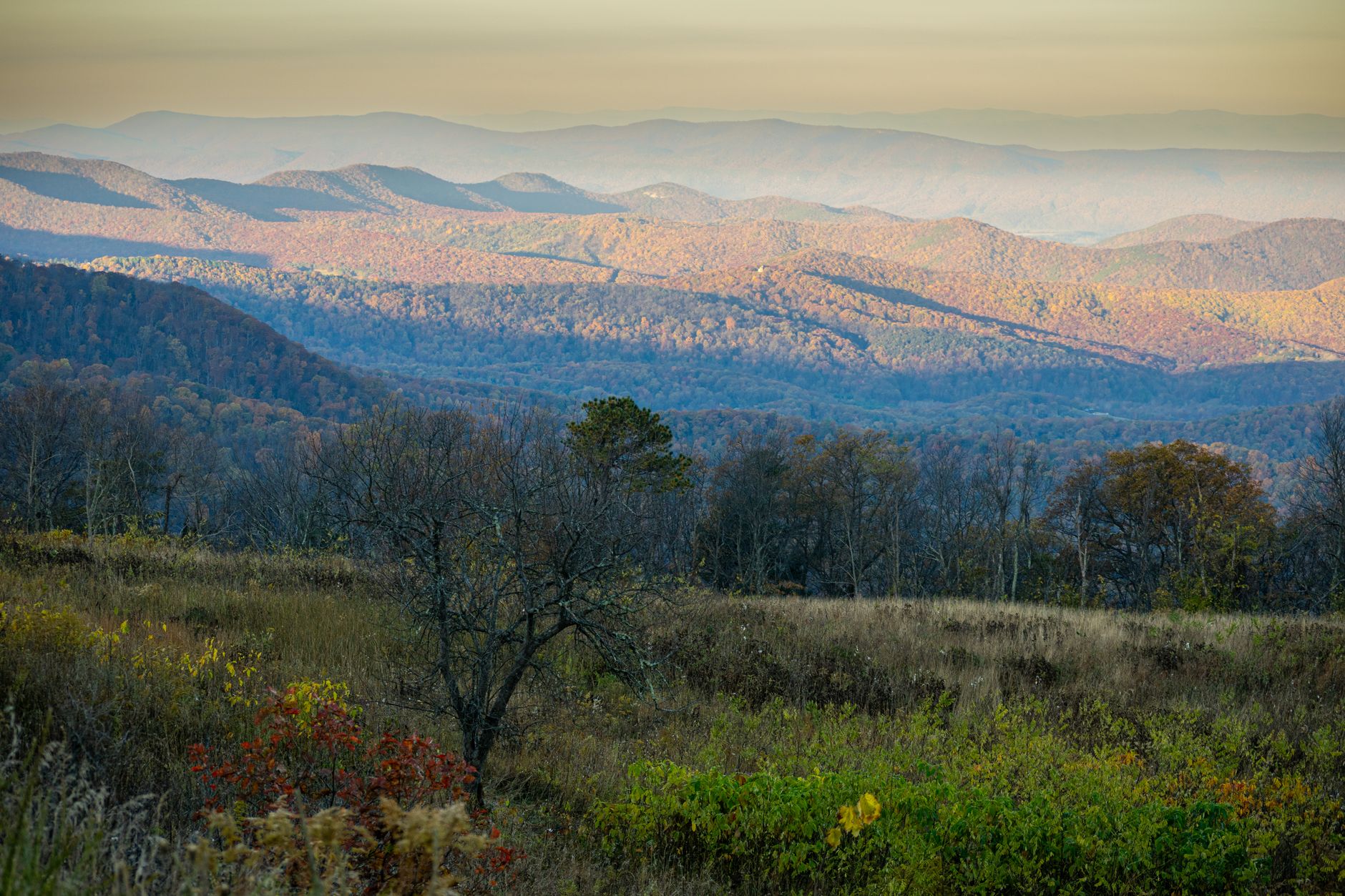
Fall (late September–early November): The main event. Shenandoah’s fall foliage is legendary, and the color rolls down from the high ridges over several weeks. Peak is usually early to mid-October, but it varies year to year with weather. Expect glorious color — and serious crowds and traffic on Skyline Drive, especially on October weekends. Go midweek and start at sunrise if you can.
Spring (April–May): Wildflowers, rushing waterfalls, and bright green hillsides. A quieter, underrated season. Higher elevations green up later than the valley.
Summer (June–August): Lush and warm, with cooler temperatures up on the ridge than down in the lowlands. Hazy afternoons and the occasional thunderstorm. Good for escaping DC humidity.
Winter (December–February): Quiet and stark. Portions of Skyline Drive may close during and after storms, and most facilities shut down. The solitude is real, but check conditions before driving up.
The sweet spot: Mid-October for foliage (with patience for crowds), or May for wildflowers and waterfalls with far fewer people.

Even if you never lace up your boots, the drive itself is the experience. With 75 overlooks across 105 miles, you can pull over again and again for sweeping views of the Shenandoah Valley to the west and the Piedmont to the east. Favorites include Range View, Hazel Mountain, and Spitler Knoll overlooks. Allow about 3 hours to drive the whole thing without stops — realistically a full day with overlooks and a hike or two.
The park’s most famous and most demanding hike. This roughly 9-mile loop climbs to a granite summit via a genuine rock scramble — you’ll be using your hands, squeezing through crevices, and hauling yourself over boulders. The 360-degree summit views are spectacular. It’s not for everyone: it’s strenuous, exposed in spots, and takes most people 6–8 hours. Remember the day-use ticket requirement in peak season.
Shenandoah hides a surprising number of waterfalls in its hollows. The most popular is Dark Hollow Falls (about 1.4 miles round trip, but deceptively steep coming back). For something bigger, Rose River Falls and Whiteoak Canyon (a series of cascades) reward the extra effort.
Because Skyline Drive runs along a ridge, you get both east- and west-facing overlooks. That means easy sunrise and sunset spots without a hike. Big Meadows and the overlooks near Skyland are classic.
The open expanse of Big Meadows (around Milepost 51) is one of the best places to see white-tailed deer, and the park is home to a healthy black bear population. Dawn and dusk are prime times.
| Hike | Distance | Difficulty | Why Go |
|---|---|---|---|
| Dark Hollow Falls | ~1.4 mi RT | Easy–Moderate | Closest waterfall to Skyline Drive |
| Stony Man | ~1.6 mi RT | Easy | Big views for little effort |
| Hawksbill Summit | ~1.7–2.9 mi | Moderate | Highest point in the park |
| Rose River Falls Loop | ~4 mi | Moderate | Quieter waterfall loop |
| Whiteoak Canyon | ~4.6+ mi | Moderate–Hard | Series of cascades |
| Old Rag Loop | ~9.0 mi | Hard | Iconic rock scramble + summit |
| Riprap–Wildcat Loop | ~9.8 mi | Hard | Solitude in the South District |
Easy wins: If you’re short on time or hiking with kids, pair Stony Man (huge views, gentle grade) with Dark Hollow Falls. You’ll get a summit and a waterfall in half a day.
These are the two hikes everyone asks about, and they couldn’t be more different. Here’s a quick comparison to help you choose.
| Old Rag | Dark Hollow Falls | |
|---|---|---|
| Distance | ~9 miles | ~1.4 miles |
| Time | 6–8 hours | 1–1.5 hours |
| Difficulty | Strenuous + rock scramble | Short but steep return |
| Ticket needed | Yes (peak season) | No |
| Best for | Fit, adventurous hikers | Families, casual visitors |
| Payoff | 360° summit, scramble thrill | Pretty 70-ft waterfall |
Bottom line: If you’re fit, love a challenge, and booked your ticket, Old Rag is unforgettable. If you want a quick, scenic taste of the park, Dark Hollow Falls delivers without the commitment.
Hidden Gems Most Visitors Miss
- The South District: Most day-trippers cluster in the north and central sections. Drive past Swift Run Gap and you’ll find trails like Blackrock Summit (a short, easy walk to a striking boulder field) with a fraction of the people.
- Sunrise on a weekday: The same overlooks that are jammed on October weekends are nearly empty at 6:45 a.m. on a Tuesday.
- Limberlost Trail: A gentle, partly accessible loop that’s lovely and quiet — perfect for a slow morning or visitors who want scenery without a scramble.
- Pollock Knob and lesser-named overlooks: Everyone stops at the famous ones; the unnamed pullouts are often just as gorgeous and completely empty.
Inside the park:
- Skyland (Milepost 41.7) — the highest lodging in the park, with valley views
- Big Meadows Lodge (Milepost 51) — central, historic, close to trails and the meadow
- Lewis Mountain Cabins — rustic and quiet
- Campgrounds: Mathews Arm, Big Meadows, Lewis Mountain, and Loft Mountain — reserve early in fall
Outside the park:
- Luray, VA — closest town to the central entrances, home to Luray Caverns
- Front Royal, VA — convenient for the north entrance and DC day trips
- Charlottesville, VA — a lively base near the south entrance with great food and wineries
- Layers — it’s noticeably cooler on the ridge than in the valley, and weather changes fast
- Sturdy hiking shoes — essential for Old Rag’s scramble and rooty waterfall trails
- Plenty of water and snacks — services are spread out along the drive
- Rain jacket — afternoon showers are common in summer
- Bear awareness — store food properly and keep your distance
- A full tank of gas — fuel is limited inside the park
- Your Old Rag ticket (if applicable) and a downloaded offline map — cell service is spotty
I’ll be honest: the first time I drove up to Shenandoah, I almost didn’t go. It was a gray, drizzly October Friday, and I figured the foliage would be a washout. I went anyway, mostly to escape the city.
By the time I reached the central overlooks, the rain had thinned into drifting fog, and the whole ridge looked like it was breathing. Clouds poured through the gaps between mountains, parting just long enough to reveal a valley flushed gold and crimson, then closing again. I had a pullout entirely to myself — on a peak-foliage weekend, no less — because everyone else had stayed home for the weather.
I stood there with a gas-station coffee going cold in my hand, watching color appear and disappear in the mist, and thought: this is what people drive past at 35 miles an hour. The lesson stuck with me. In Shenandoah, the “bad weather” days and the early mornings are often when the mountains show off the most.
- Book Old Rag tickets early — they’re required in peak season and they sell out.
- Start early in fall — Skyline Drive backs up badly on October weekends; sunrise is your friend.
- Don’t underestimate “short” hikes — Dark Hollow Falls is brief but the climb back is steep.
- Fill up on gas before entering — fuel stops are minimal inside the park.
- Watch your speed — the 35 mph limit is enforced and there are lots of deer.
- Download maps offline — cell coverage is unreliable along the ridge.
- Check road status in winter — Skyline Drive closes in bad weather.
Day 1 — Central District highlights: Enter at Thornton Gap, drive south stopping at overlooks, hike Stony Man for easy big views, then Dark Hollow Falls in the afternoon. Spend the evening watching sunset and looking for deer at Big Meadows.
Day 2 — Big hike or scenic south: If you’re fit and ticketed, tackle Old Rag early. Prefer something mellower? Drive the South District, hike Blackrock Summit, and enjoy the solitude before exiting at Rockfish Gap (or continuing onto the Blue Ridge Parkway).
Do you need a reservation to visit Shenandoah National Park? You don’t need a general reservation to enter — just pay the per-vehicle entrance fee. However, the popular Old Rag hike requires a separate day-use ticket during peak season (roughly March through November), which you book in advance on recreation.gov.
How many days do you need in Shenandoah? Two days is ideal — one for Skyline Drive, overlooks, and a waterfall hike, and one for a bigger hike like Old Rag or exploring the quieter South District. You can see the highlights in a single long day if you focus on the Central District.
When is the best time to see fall foliage in Shenandoah? Peak color is usually early to mid-October, though it shifts year to year with the weather. Higher elevations turn first. Weekends in October are extremely crowded, so visit midweek or start at sunrise.
Is Old Rag worth it, and how hard is it? Old Rag is one of the most rewarding hikes on the East Coast — a roughly 9-mile loop with a genuine rock scramble and panoramic summit views. It’s strenuous and takes 6–8 hours for most people, so it’s best for fit, confident hikers. Don’t forget the day-use ticket in peak season.
Before you go, check current entrance fees, the Old Rag ticket system, and Skyline Drive conditions on the official Shenandoah National Park site.
Shenandoah proves you don’t need to fly across the country to find real mountain wilderness. With Skyline Drive as your spine, a tank of gas, and a couple of good hikes booked in, you can trade the noise of Washington DC for misty Blue Ridge ridgelines in under two hours. Whether you’re scrambling up Old Rag, chasing waterfalls into the hollows, or just pulling over at overlook after overlook in peak October color, this is one of the easiest big-payoff escapes in the East. Beat the crowds with an early start, and the Blue Ridge will reward you every time.
Chasing more mountain color? Don’t miss our guide to the Great Smoky Mountains, the Best National Parks for Fall Foliage, and the Best Sunrise Hikes in the USA. Map out your trip with our free Trip Planner.
🌍 Plan & Book Your Trip
Best deals powered by Travelpayouts:
Affiliate links — no extra cost to you.